
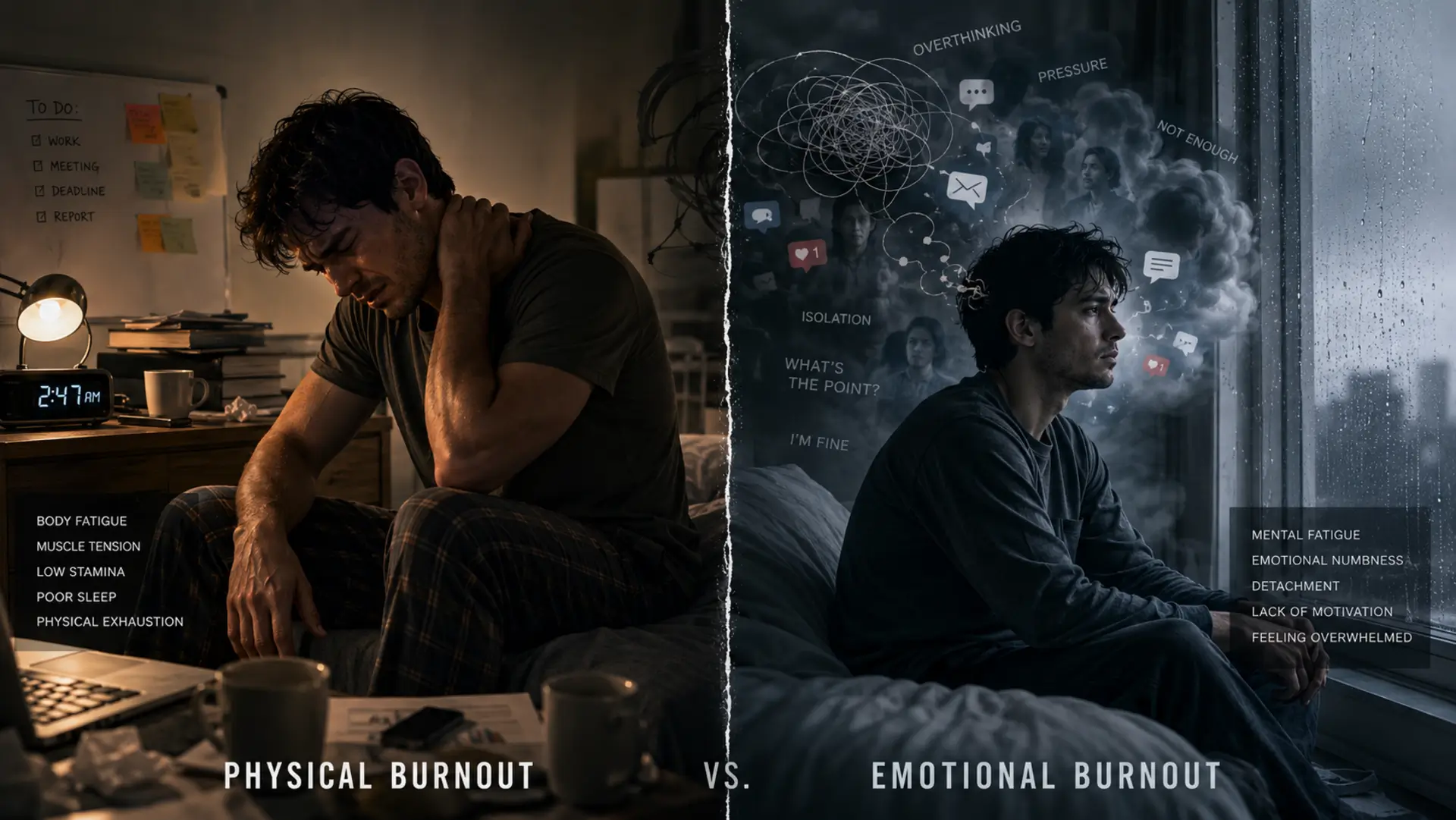
There are days when getting out of bed feels like lifting something heavy. When even small tasks require effort that seems disproportionate to what they actually are. When rest stops feeling restorative.
Most people call this burnout. But not all burnout is the same, and understanding which kind you are experiencing can make a real difference in how you recover from it.
Both emotional and physical burnout share some common ground. Fatigue. Low motivation. A general sense of depletion. You may feel like you are running on empty regardless of which type you are dealing with, which is why the two are so often confused or treated the same way.
But they have different origins, show up differently in the body and mind, and respond to different kinds of care. Treating one as if it were the other is one reason people sometimes feel like nothing they try is actually working.
Physical burnout is rooted in the body. It tends to develop when the body has been under sustained physical strain through overwork, insufficient sleep, illness, physical caregiving, or simply not giving the body what it needs over a prolonged period.
The signs are largely physical: persistent tiredness that lingers even after a full night of sleep, low stamina, frequent aches or tension, slower recovery from exertion, and a body that feels like it is constantly running behind.
The key marker of physical burnout is how you respond to rest. If a proper night of sleep, a restful weekend, or a few days away from physical demands leaves you feeling noticeably better, your body was asking for recovery and it received it.
Emotional burnout works differently. It is driven not by physical strain but by sustained emotional and mental load: ongoing stress, difficult relationships, caregiving, high-pressure work environments, or simply carrying too much for too long without adequate support or relief.
The signs here are more internal: irritability without an obvious cause, a sense of detachment from people or things you usually care about, difficulty concentrating, a flattening of emotion, and a persistent feeling of being overwhelmed that does not seem connected to any single event.
The crucial difference is what happens after rest. Someone experiencing emotional burnout may sleep a full eight hours and wake up feeling just as drained as the night before. The body has rested, but the mind has not actually recovered. Rest, in the traditional sense, does not resolve it because the source of the depletion is not physical.
Pay attention to your recovery pattern.
If proper sleep and physical rest consistently restore your energy, what you are likely experiencing is physical burnout. Your body was overextended and is now recovering.
If you wake from sleep still feeling heavy, unmotivated, or emotionally flat, if a weekend away does not lift the weight, emotional burnout is more likely. The exhaustion you feel is not about what your body has done. It is about what your mind has been carrying.
This is not an absolute distinction. Both types can coexist, and chronic physical exhaustion often affects emotional resilience, just as emotional burnout can manifest in physical symptoms. But noticing your recovery pattern is a useful starting point.
Physical burnout responds well to physical restoration. This means prioritising sleep and giving the body consistent, quality rest. It means attending to basic needs, hydration, nutrition, and reducing physical overload. Taking breaks that genuinely allow the body to recover, rather than simply switching from one form of activity to another.
The body is resilient when given the right conditions. Physical burnout, addressed with care, is something most people recover from relatively straightforwardly, though it does require actually slowing down, which is harder than it sounds.
Emotional burnout requires a different kind of attention. Because the source is mental and emotional, recovery involves working with that level, not just resting the body.
This often means setting boundaries around the situations or demands that are draining you. Not every source of emotional depletion can be removed, but many can be reduced. It means taking intentional breaks from stressors, not just being physically still, but genuinely stepping away from the mental weight of something.
Engaging in activities that restore rather than demand mental energy matters too. For different people, this looks different at different times in nature, creative outlets, movement that feels enjoyable rather than obligatory, or simply quiet time with no expectations attached.
And sometimes, it means talking things through with someone you trust. Emotional burnout often involves a sense of isolation, a feeling of carrying something alone. Being heard, even once, can shift that considerably.
When we misidentify what is happening, we tend to apply the wrong solutions. Someone
experiencing emotional burnout who responds only by sleeping more may find little
improvement. Someone with physical burnout who focuses entirely on mental strategies while
continuing to neglect the body will hit the same wall again.
Neither type of burnout means something is fundamentally wrong with you. Both are signals that
the body or the mind is communicating that something has exceeded its sustainable limit for too
long.
© Soul Compass – Powered by Kefitup